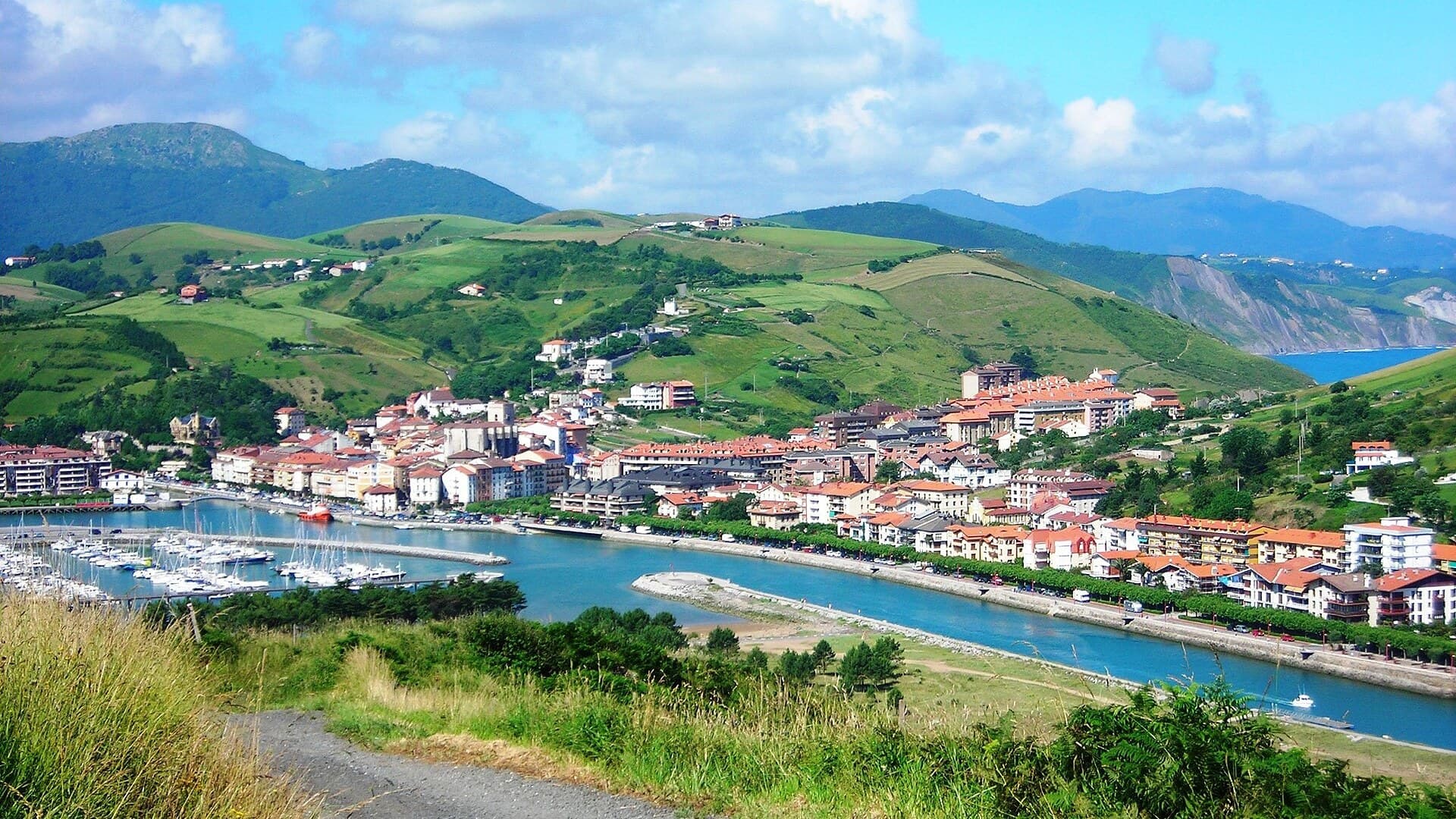
Zumaia is a town on the Cantabrian coast in Gipuzkoa, in the Basque Autonomous Community. Spanish is Zumaya; the official name is the Basque one. Census counts put the population around ten thousand, most of them in the urban core. Treat it as a town of about ten thousand, not a village and not a city. The centre sits near 43.30 N, 2.26 W. Postcode 20750. Elevation about 20 metres. Municipal area 11.20 square kilometres.
The Urola and the Narrondo meet the sea here. Two beaches sit in the cliffs: Itzurun and Santiago. Between Deba and Getaria, for about eight kilometres, the coast is flysch: tilted sandstone and mudstone that records from the mid-Cretaceous into the present. The Cretaceous-Paleogene boundary is visible at Itzurun. Ammonite fossils turn up. In 2022 the International Union of Geological Sciences listed the Zumaia section among one hundred geological heritage sites. Since 2010 the town shares the Basque Coast UNESCO Global Geopark with Deba and Mutriku. The official Geoparkea pages run boat and walking visits from the Zumaia quay when the sea allows.
This is not San Sebastián. Zumaia lies about thirty kilometres west of that city, a short coastal hop from a city of nearly 190,000, La Concha, and a pintxo street. Zumaia is the flysch stop. People who actually use it come for the wave-cut platform at low tide, a marked coast walk, or a geopark boat. Nightlife as Donostia means it, a shopping street, a week of museums: stay on the train.
One long day from San Sebastián covers the station, the old core, and Itzurun if the tide is out. Two days earn their keep if you walk toward Deba or take a Geoparkea boat when the sea is flat. A third night is padding unless you are stringing Getaria and Deba on the same coast. Do not invent a week in a town of this size.
The town is walkable and small. Euskotren Trena runs the narrow-gauge line that links San Sebastián with Zarautz, Zumaia, Deba and on toward Bilbao. The AP-8 motorway and the N-634 also pass the municipality. You do not need a car inside the streets. You do need a tide table for the platform, and weather for the boat. Families who want a city beach should stay in Donostia. Couples who want the cliff and a quiet night can use Zumaia if they accept that the bars belong to a working fishing town. Do not use Zumaia as a place to work.
The flysch, the geopark, a day off the San Sebastián ticket: yes. A substitute for San Sebastián: no. Postal code 20750.
How a walled villa sat down on the flysch
The name is usually tied to Basque zume, wicker, for the wet ground where the rivers meet. A parchment of 1292 records Sancho VI of Navarre giving the monastery of Santa María to Roncesvalles. Historians agree the settlement grew around that house. On 4 July 1347 Alfonso XI of Castile granted the people of the Seaz valley the privilege to populate Villagrana de Zumaya under the fuero of San Sebastián, with walls, a mayor and jurisdiction. The Gothic church of San Pedro, built after that founding, still reads as a defensive block: 30 metres long, a 34 metre tower.
The town sat at the mouth of a working river and took pirate raids seriously enough to fortify. A first documentary mention dates to 1292. A rail accident in 1941 killed 26. The coastal Camino passes through as a line, not a reason the town exists. Ignacio Zuloaga lived here; his house is now a museum with older Spanish painting. That is a half-day, not a museum city.
The flysch was always the cliff. Only later did geology make it the reason strangers stop.