Sorbas is a municipality in Almería province, Andalusia, Spain, in the Levante Almeriense. The village sits near 37.10 N, 2.12 W, about 402 to 410 metres up, with roughly 2,564 people and postcode 04270 in a municipality of 249 square kilometres. The town sits 65 kilometres from the provincial capital. This is the hanging-house village over the Afa, not Cuenca in Castilla-La Mancha, and not the film desert by itself.
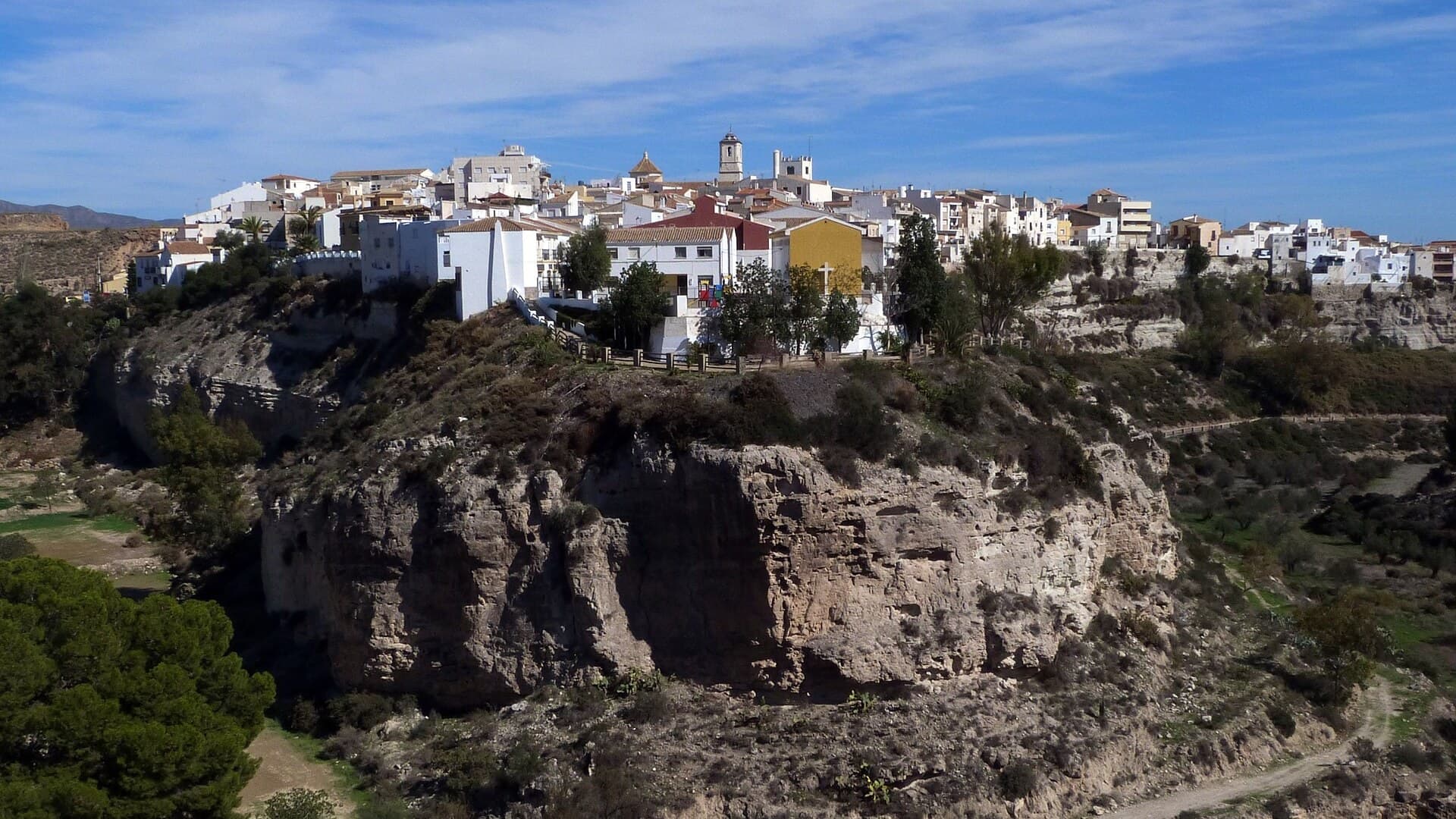
Locals call it Cuenca chica because the houses hang over the barranco of the Afa, like the Casas Colgadas in Cuenca. The Río de Aguas and the Rambla de Sorbas cut the gypsum. Around the village lies the Paraje Natural Karst en Yesos de Sorbas: more than a thousand linked cavities, with the interpretation centre Los Yesares, the Urrá viewpoint, and the Yesares path. The municipality opens east toward the Tabernas Desert and northeast toward the Vera and Almanzora valleys. Tabernas, about 30 kilometres north of Almería city, is the film-set desert most visitors mean. Sorbas is the village base, not the dune.
People who actually use the town come for the gorge view, the gypsum caves, and a night off the Almería coast. Pottery still burns in an Arab oven in Las Alfarerías. The Placo Saint-Gobain gypsum quarries are described as the largest in Europe. That is industry, not a tour. Nightlife, a beach week, a café with all-day power: Almería or Mojácar.
One full day from Almería covers the hanging houses, a walk of the miradores, and a booked cave visit if the centre is running. Two nights fit the karst and a drive into Tabernas. A third day only earns its keep if you add Cabo de Gata or the Almanzora. A week only in the village is too much village.
The old streets are walkable, steep, and Arab in plan. There is no metro and no tram. The A-7 crosses the municipality between kilometres 497 and 513. The N-340a is the old road toward Murcia via Tabernas. You do not need a car to cross the plaza. You do need one for the karst car parks and for Tabernas. Families who want a flat promenade should stay on the coast and come for the day.
The hanging houses, the gypsum caves, a desert day without sleeping in a film set: yes. A Cuenca copy, a beach holiday, a laptop month: no. Do not file this under the Casas Colgadas of Cuenca, and do not treat the AVE tunnel through the term as a station in town.
Sand pot on a gypsum gorge
Eleventh-century maps already show the name Surba. Arab sources in that telling give olla de arena, sand pot. Others derive Serva or Servula, a Roman servant town. Bronze Age burials turned up in El Calvario. An Iberian settlement traded with Phoenicians. Romans worked lapis specularis, the gypsum, and left road traces in the term.
In 1089 Abd Allah cites Surba as a castle in dispute. The Catholic Monarchs took it in June 1488 after Vera. Diego López de Haro received the señorío of Sorbas and Lubrín in 1502. After the Alpujarras war, moriscos were expelled and the land was regranted in 1577 and 1578. Carboneras split away in 1838. Late nineteenth-century counts sat near 5,098. The later twentieth century sent people to Catalonia and Europe. From 2010 to 2020 the municipality lost about 16 percent of its people.
The parish church of Santa María went up in 1592 on the mosque. Pottery families in Las Alfarerías still use a Hispano-Muslim kiln. The hanging houses are the reason the gorge has a nickname. They are not the Casas Colgadas of Cuenca.