
Uquía Guide
Adobe chapel, carnival devils and coloured mountains
1 selected
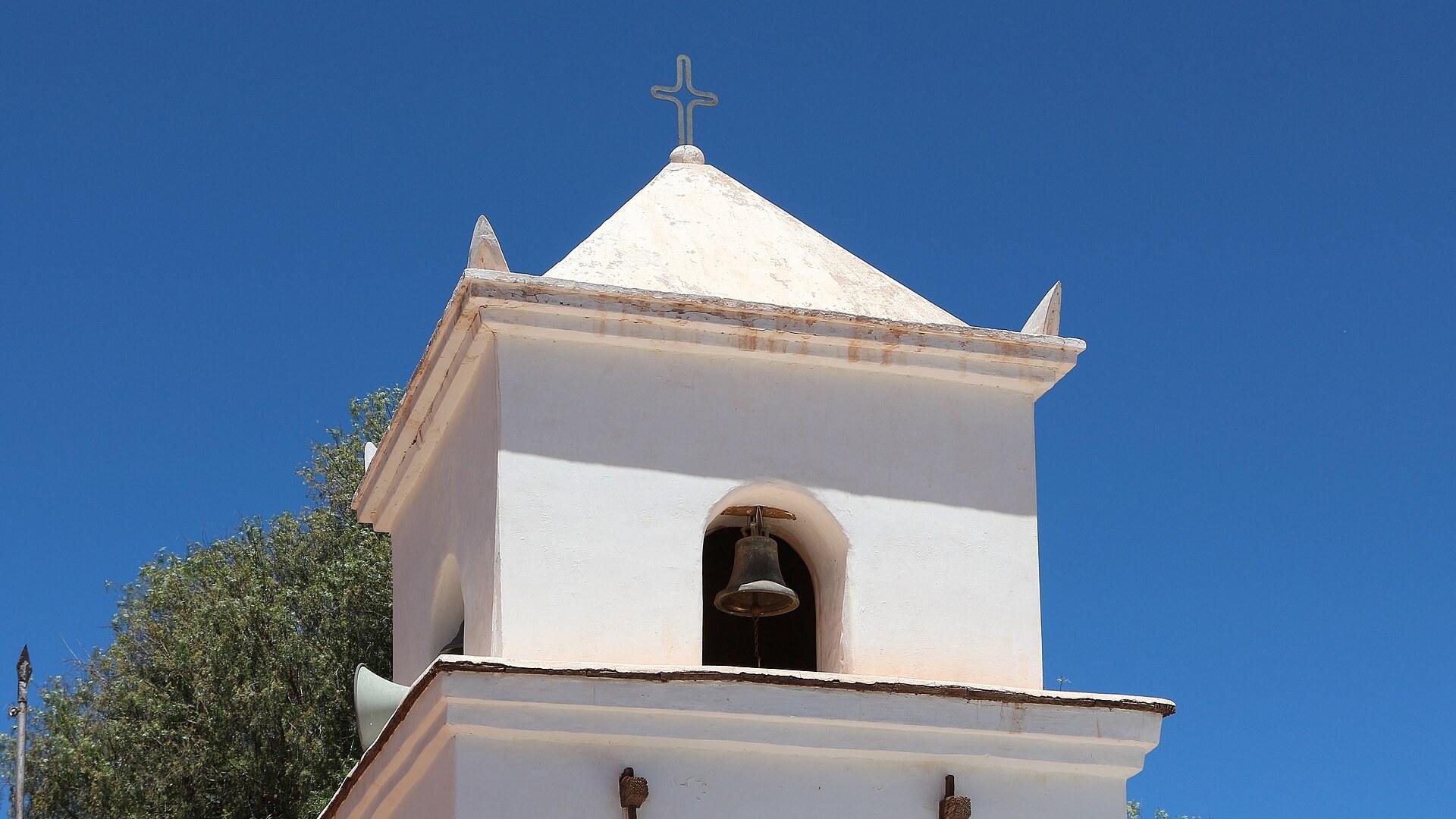
Uquía is a village in Jujuy, in northern Argentina, set in the Quebrada de Humahuaca. Agriculture, handicrafts, pottery and tourism are its main activities, and the streets stay quiet among colourful mountains. Around the world, people know Uquía for the carnival devils and for the Ángeles Arcabuceros of its church.
The chapel of the Santa Cruz y San Francisco de Paula has a single nave facing east, a closed atrium, a detached tower and a sacristy against the north wall. At the end wall stands a gold-leaf altarpiece with three streets and three bodies, described as unique in the region. The art collection holds paintings, sculptures and a liturgical object of the 17th-century Cuzco school, led by the 9 Ángeles Arcabuceros. Beside the church grows a molle tree that once shaded General Belgrano on his way through the quebrada.
The recent restoration followed old methods. Laying the thick mud layer on the roof took 12 h of continuous work, with the adobe carried up bucket by bucket. The church was repainted by brush with lime, salt and prickly-pear pad, and a mesh of ropes and knots called drizado reinforced the nave, a Peruvian technique used in Argentina for the first time.
Potters and other artisans show their work in the plaza every day of the year. The Paseo de Artesanías, just before the main plaza, has 30 craft stalls of 2x3 m in two groups of 15, built with wooden frames and cane roofs covered in mud. Works around the plaza began in January 2021 and added walkways, benches and eight lamps. A shop on the main road lets you pose for a photo with a llama.
The quebrada de las señoritas walk leaves the village past the cemetery and the carnival marker of Los Alegres de Uquía, then continues through small caves and coloured mountains. Wind and water shaped the figures in the rock there, and a legend links them to three women carrying Potosí silver. Across the Río Grande stand a mill from 1925 with 19th-century millstones and a vicuña breeding farm of the Robles family.
Carnival centres on the bajada de los diablos by the comparsa Los Alegres de Uquía, when more than 400 devils come down before more than 50 thousand spectators gathered in front of the cerro blanco. The festival de la chicha y la copla opens the local carnival with verse contests and chicha. On 3 May the village marks the Day of the Cross and San Francisco de Paula with serenades, processions, sikuri bands, gauchos, horse-breaking and folklore.
Near Humahuaca, Peña Blanca is a giant white-and-red desert rock reached by a 25 min hike, with a shrine built into its side. The Ruinas de Coctaca cover 40 ha of pre-Columbian terraces and a complex watering system, the largest archaeological site in northern Argentina. The Pucará de Tilcara is a pre-Columbian fortress of the Omaguaca, and Purmamarca is known for the Cerro de los Siete Colores.
A 17th-century chapel and its long restoration
Uquía took shape in the second half of the 17th century as an annex of the Humahuaca encomienda, almost a century after San Antonio de Humahuaca and San Francisco de Tilcara. The first mention of a chapel here is from 1691, when Father Vieyra de la Mota reported that building had begun in the village of San Francisco de Paula. The main altarpiece is said to be a gift of 1699 from Lázaro Murueta, lieutenant governor of Jujuy and protector of the Uquía people. The village kept its own Gobernador de Indios, and two religious brotherhoods chose their stewards at the festival of San Francisco de Paula. The Jesuit priest and historian Pedro Lozano died in Uquía in 1752 or 1753. Tradition puts his grave somewhere in the nave, but nobody knows where. The adobe walls are 1 m thick and carry a gabled roof with a pair-and-knuckle frame, a cardón-wood ceiling and a mud finish. A silver key of 450 g opens the main door every day, as it has since 1691. Between 1930 and 1940 the tower lost its adobe dome and received a reinforced-concrete pyramid, and on 14 July 1941 the church became a National Historic Monument. A survey in November 2019 found four cracks, rotting original wood and serious damage to roof, walls and beams. Restoration began in 2019 with money from the national Ministry of the Interior, and CONICET researchers studied the problems in the adobe. Work stopped from March to August 2020 because of the pandemic. The governor, Gerardo Morales, inaugurated the restored church and the new Paseo de Artesanías on 23 April 2021. During the works the 9 Ángeles Arcabuceros, which belong to the Prelatura de Humahuaca, were kept in Humahuaca and in the Casa Parroquial behind the church. The wider Quebrada de Humahuaca became a protected landscape in 2000 and a World Heritage Site on 2 July 2003. A decree of 1941 protected six key chapels and churches of the quebrada as Historical Monuments.
Wine from Viñas de Uquía and empanadas up the road
Viñas de Uquía is a lodge with a small organic winery, considered the highest in America and Europe, and its Uraqui Minero Corte A 2016 earned praise from Tim Atkin in his 2018 report. Other wineries of the quebrada include Fernando Dupont in Maimará, Viñas del Perchel between Tilcara and Huacalera at 2625 m above sea level, and the Yacoraite Vineyards. Together, Jujuy producers make about 15,000 bottles a year, high-altitude wines ripened by thermal amplitude and wind. In Humahuaca, Pachamanka Restaurante serves regional dishes such as fried empanadas and llama meat. In the afternoon, stands there sell tortillas, which in this region means a large, flat empanada. San Salvador de Jujuy has many restaurants with traditional dishes such as tamales, empanadas and asado, and the street food near the bus stop is excellent.
Reaching Uquía along Ruta Nacional 9
Uquía lies on Ruta Nacional 9, 16 km north of Huacalera and 12 km south of Humahuaca. Most buses between San Salvador de Jujuy and La Quiaca on the Bolivian border stop at Humahuaca, the nearest main bus hub for Uquía. Local buses run from Humahuaca to smaller towns such as Uquía and Purmamarca. The Balut company runs a La Quiaca to Salta bus that stops at Humahuaca and needs 5½ h to reach Salta, although it frequently runs late. Buses from Humahuaca to places south of Jujuy are much less frequent, so a bus to Jujuy and a change there can work better. The main border crossing from Bolivia into Jujuy links Villazón in Bolivia with La Quiaca in Argentina, and buses leave from the La Quiaca terminal to other parts of Jujuy. Buy your ticket in the country where most of the journey takes place, since refunds or reductions for split or delayed journeys are hard to get once you cross the border. The Quebrada de Humahuaca is 1,649 km north of Buenos Aires. It is a corridor of 155 km running north to south along the Río Grande valley and the Camino Inca. Towns in Jujuy Province are well connected by bus, while remote natural attractions need a car or a paid private car or tour.
Humahuaca bus station, shared cars and the Tren Solar
Around Uquía, the practical base is Humahuaca, where the bus station stands a few blocks southwest of the centre and has luggage storage, food and toilets. Humahuaca is too small for any transport other than walking. Shared cars and vans to the Serranía de Hornocal viewpoint leave from the Humahuaca bus station and take about 40 min. Since June 2024 the Tren Solar de la Quebrada has run on a 42 km stretch through the Quebrada de Humahuaca, partly along the Qhapaq Ñan Inca road, powered by six lithium batteries charged by solar energy. San Salvador de Jujuy has an extensive local bus system. Route information is hard to find, and some routes are listed on the Moovit app.
Banks, WiFi and mobile signal around Uquía
In April 2021 the governor announced home fibre-optic internet connections for Uquía in the first half of May. He also announced 4G mobile service by the end of June or the first half of July. The only bank in Humahuaca is Macro on the central plaza, part of the RedBrou network, and there are two Western Union branches in town. Internet is slow in Humahuaca because of its isolated mountain location, and hostels and some restaurants have WiFi.
Practical questions about Uquía and the Quebrada
In the Uquía church, visitors to the Ángeles Arcabuceros collection are asked not to take photos in any way, which helps to conserve the paintings. Is altitude a problem? Altitude sickness is the biggest concern in the largely rural Jujuy region, so take it easy when ascending to high altitudes. How high is the Hornocal viewpoint? At Serranía de Hornocal, near Humahuaca, the viewpoint is at 4,350 m above sea level. The walk takes 20 min, and the way back is steep and hard if you are not acclimatised. When is the light best at Hornocal? The afternoon is best, when the colours show their full range. Which languages do people speak? Most people in the Jujuy region speak only Spanish, but many people from Bolivia and Peru speak Quechua. What is the Río Grande like? In the Quebrada de Humahuaca the river is dry in winter and flows copiously through the valley in summer.
FAQ
What is covered in the Uquía guide?
Discover Uquía in Jujuy, Argentina: the adobe church with the Ángeles Arcabuceros, carnival devils, craft stalls and a walk through coloured mountains. It includes 1 recommendations across 1 gallery.
Next →How many places are in the Uquía guide?
The Uquía guide lists 1 places: 1 gallery.
Next →Where is Uquía?
Uquía is in Uquía, Jujuy, Argentina (-23.3030, -65.3557).
Next →How do you get to Uquía?
Uquía lies on Ruta Nacional 9, 16 km north of Huacalera and 12 km south of Humahuaca. Most buses between San Salvador de Jujuy and La Quiaca on the Bolivian border stop at Humahuaca, the nearest main bus hub for Uquía. Local buses run from Humahuaca to smaller towns such as Uquía and Purmamarca. The Balut company r…
Next →What should you eat in Uquía?
Viñas de Uquía is a lodge with a small organic winery, considered the highest in America and Europe, and its Uraqui Minero Corte A 2016 earned praise from Tim Atkin in his 2018 report. Other wineries of the quebrada include Fernando Dupont in Maimará, Viñas del Perchel between Tilcara and Huacalera at 2625 m above…
Next →Is there camping in Uquía?
No camping listings in this pack yet — we do not invent venues. Entries will appear once verified.
Next →Can you rent a bike in Uquía?
No bike rental listings in this pack yet. Verified shops will be added when available.
Next →What are recommended gallery in Uquía?
Highlighted gallery in the Uquía guide: Church bell tower.
Next →Highlighted places
- Church bell tower — The whitewashed bell tower of the Capilla de la Santa Cruz y San Francisco de Paula in Uquía.
Explore on the map
Tap a pin to highlight its place card
All
1 spots
Recommended places
Gallery
1 · 1 selected
Church bell tower
gallery
Related guides
Browse nearby destinations
Angastaco Guide
Salta, Argentina
Torrontés wine and red hills in Salta's Calchaquí valley
Molinos Guide
Salta, Argentina
Adobe lanes, a colonial church and vicuña wool
Seclantás Guide
Salta, Argentina
Looms, adobe lanes and valley views in Salta
Adrasan
Antalya, TR
A pine-backed bay where the days move slowly
Air Batang
Pahang, Malaysia
A car-free Tioman village for divers and walkers
Akyaka
Muğla, Türkiye
Azmak boats, kitesurf wind and wooden balconies

Save these places to your list
Copy the spots you picked into your list — maps and notes included.