
Palmarin Guide
Mangroves, salt pools and shell mounds on the Petite Côte
1 selected
Palmarin sits in the Fatick region of Senegal, a rural community that runs along a 17 km peninsula on the southern stretch of the Petite Côte. Atlantic sandy beaches face west, while the Palmarin reserve spreads out to the east. That reserve is a patchwork delta of mangrove channels, salt flats, grass lands and forest.
Most residents live in five villages. From north to south they are Ngallo, Ngueth, Gounamane, Diakhanor and Djiffer. Traditional fishing, tourism, salt, and the harvesting of oysters and clams are the main industries here.
The reserve is where the wildlife is. Hyenas, jackals, ancient baobabs, critical mangrove systems and a wide range of resident and migrant birds all live there. Expeditions to see the wild hyenas can be arranged through accommodation providers or the Reserve de Palmarin Eco Guides.
On the water, Sangomar Kayak runs half-day kayak excursions through the winding mangrove channels, with lunch or overnight camping as options. Kayakers in the Palmarin mangroves often see pelican, flamingo, heron, kingfishers and weavers. Mongoose, monkeys and monitor lizards turn up more rarely.
Back on land, a site on the beach north-west of Ngallou shows artisanal fish transformation. Capoeira lessons are offered on the beaches, and in Diakhanor the women braid hair for visitors over three cups of tea. You can also learn traditional cast-net fishing from local fishermen.
Sereer dancing happens in a circle, where two or three dancers at a time perform for roughly thirty-second bursts to drummers playing jambays or tam tams. Njoom, the traditional Sereer wrestling, is held in nearly every Sereer village, Palmarin included. Striking is illegal in it, and the aim is to topple the opponent so that his back or both hands and knees touch the ground.
Shell mounds, the Kingdom of Sine and a community reserve
The history of Palmarin runs through the Kingdom of Sine, which once included the village and whose trade in ivory and fur it joined during the 19th century. Palmarin also lies between Joal-Fadiouth and Djifer, near Sangomar Point in Sine-Saloum. Early residents of the area piled up dozens of mounds from harvested clam shells, and some of them rise up to forty m. Many of the artifacts found there are now kept in the Palmarin Eco Museum. Some mounds near Palmarin were dug up for road building material before the region received world heritage status. The Palmarin community reserve, called Réserve Naturelle Communautaire de Palmarin, was designated in 2001 and covers 10,430 hectares. The area has also received a special UNESCO designation. Saloum Delta National Park, a separate protected area, was established in 1976, covers 760 square kilometres and belongs to a UNESCO World Heritage Site about 100 km south of Dakar. In Joal-Fadiouth, the island of Fadiouth is built primarily of sea shells and is the main attraction of the town, which tour operators include on their circuits. The Fadiouth cemetery is covered in shells, with Muslim and Christian graves close together, and the unused granaries between cemetery and town are a World Heritage site. Joal-Fadiouth is also the birthplace of Léopold Sédar Senghor, Senegal's first president. His childhood house can be visited to learn about the history of Joal in colonial times.
Salt, local cooking and fish markets near Palmarin
Palmarin has two dining establishments outside the lodges, Chez Mitcheo in Ngallou village and Le Trou du Fu in Gounoumane. Chez Mitcheo stands east of the main road and serves local cuisine. Le Trou du Fu is near the Stade de Lutte. Salt harvested in the Palmarin pools is sold locally, and a sack of it turns up at the lodges or in the village. The evaporation pools lie just east of Ngallou. Seasonal floods and tides fill them with ocean water, and the salt is harvested as the pools dry in the dry season. Palmarin has three artisanal markets. Marché de la Plage is just south of the Royal lodge, Marché du Mangrove is on the beach behind the Lodge de Palmarin, and Chez Mendy is off the main road in Ngallou. The fishing port of Joal is described as the largest artisanal fishing port in West Africa, and it is best visited around 09:00 and 18:00, when the boats return with their catch. In Mbour, the beach fish market is best visited in the late afternoon when the fishing boats arrive, and you should ask permission before photographing people.
From Dakar to Palmarin by car, sept place or bus
To reach Palmarin by car from Dakar, you take the N1 through Mbour and Joal, then follow the signs pointing south at Samba Dia. The route from Dakar to Joal via Mbour is straightforward and on good roads for those driving their own vehicle. Joal-Fadiouth lies on the Petite Côte 35 km south of Mbour and is the last big town on the road before Palmarin. After Joal the road changes from asphalt to laterite. Its poor quality can make it impassable in the rainy season without a 4x4. By public transport from the Dakar garage, you take a sept place or a rapid bus to Mbour, then a sept place from Mbour to Djiffer, the southernmost Palmarin village. Passengers on that sept place can ask to be dropped at their lodge or at one of the Palmarin villages before Djiffer. An alternative route runs from Dakar to Joal by public transport, then by another vehicle from Joal to Palmarin. In Joal, a clando taxi links the northern garage to the southern garage. Across Senegal, set the price with a sept place driver before agreeing, expect luggage to cost extra, and buy two seats for more comfort. Travel to Palmarin can also be organized through the area's lodging establishments, whether by private car or by public transit.
Charrettes, clandos and guided excursions
Horse-drawn carts called charrettes are a local way to reach the Palmarin reserve, the villages and the beaches at a slow pace. Tours with a guide are organized on request. Offshore fishing in artisanal boats near Palmarin can be arranged through accommodation providers, local guides or the Palmarin Office of Ecotourism. Guides based in Palmarin also organize excursions in the Sine Saloum region, the Gambia and the Casamance. On Mar Lodj, campements arrange kayak trips, fishing in mangrove channels, charrette or horseback tours and nature walks, and they can arrange visits to Pointe de Sangomar. The island of Fadiouth in Joal-Fadiouth has no motorised transport. In Mbour, clando route taxis run up and down the Rue Nationale, and a clando also runs from Mbour to Saly.
CFA francs, cash machines and small bills
Anyone paying in Palmarin uses the currency of Senegal, the West African CFA franc (XOF), which is fixed at 655.957 CFA francs to the euro. Ecobank ATMs accept MasterCard and Visa. Outside the major cities in Senegal, ATMs are non-existent and credit card payments are rare, so break large notes into small bills early.
Seasons, the tourism office and practical questions
Palmarin has a hot semi-arid climate with no rainfall from November to May. August is the wettest month at 277 mm, and the annual rainfall comes to about 700 mm. When is the best time to visit Palmarin? The drier months from November through May are the best travel season, with little rainfall, lower humidity and milder temperatures of around 25°C. The wetter months run from June through October, with rising temperatures that peak around August through October. How hot does it get? The mean daily maximum in Palmarin is 31.7°C in January and reaches 34.2°C in March. January nights drop to a mean minimum of 15.9°C. Where can I get information and book tours? Palmarin has a Bureau de l'Écotourisme, where visitors can get information on local events and make reservations with tourism operators. The tourism office also runs regular scheduled events such as artisanal markets, cultural music and dance demonstrations and informative classes. Where can I stay? The Lodge de Palmarin lies just south of Diakhanor along a quiet stretch of the Petite Côte, and Yokam in Gounoumane has nearly a dozen rooms of varying styles. The Djidjack lodge in Gounoumane has an extensive library in its main lodge and a sacred baobab that the local Sereer regard as the home of a spirit called Cupaan. La Pointe de Sangomar lodge near the port of Djifer has grass-walled, thatched-roof bungalows and a private beach for watching fishermen's pirogues pass. Which languages are spoken? French is the official language of Senegal and Wolof is widely spoken, so basic Wolof greetings help. The local dialect around Palmarin is a Sereer variety, and French and Wolof are also common in the villages. Do I need a vaccination? A yellow fever vaccination certificate is required to enter Senegal, though it is not checked regularly. Is bird watching worthwhile? Bird watching around Palmarin is rewarding because coastal, estuary and forest habitat meet, and the wider Senegambia region hosts over 600 species of migratory and resident birds. Saloum Delta National Park lies on the East Atlantic Flyway, with royal tern, greater flamingo, Eurasian spoonbill and curlew sandpiper among its breeding or wintering birds. Are there events worth timing a trip around? Mar Lodj holds annual wrestling competitions during a weekend in January, with each village running its own 3-day competition. Joal-Fadiouth has a tourist season from November to around April, a pleasant sea breeze, and is cooler than most places in Senegal.
FAQ
What is covered in the Palmarin guide?
Ready to plan a trip to Palmarin in Senegal? Paddle mangrove channels, see salt pools and shell mounds, and find the road and bus routes from Dakar. It includes 1 recommendations across 1 gallery.
Next →How many places are in the Palmarin guide?
The Palmarin guide lists 1 places: 1 gallery.
Next →Where is Palmarin?
Palmarin is in Palmarin, Fatick, Senegal (14.0167, -16.7667).
Next →How do you get to Palmarin?
To reach Palmarin by car from Dakar, you take the N1 through Mbour and Joal, then follow the signs pointing south at Samba Dia. The route from Dakar to Joal via Mbour is straightforward and on good roads for those driving their own vehicle. Joal-Fadiouth lies on the Petite Côte 35 km south of Mbour and is the last b…
Next →What should you eat in Palmarin?
Palmarin has two dining establishments outside the lodges, Chez Mitcheo in Ngallou village and Le Trou du Fu in Gounoumane. Chez Mitcheo stands east of the main road and serves local cuisine. Le Trou du Fu is near the Stade de Lutte. Salt harvested in the Palmarin pools is sold locally, and a sack of it turns up at…
Next →Is there camping in Palmarin?
No camping listings in this pack yet — we do not invent venues. Entries will appear once verified.
Next →Can you rent a bike in Palmarin?
No bike rental listings in this pack yet. Verified shops will be added when available.
Next →What are recommended gallery in Palmarin?
Highlighted gallery in the Palmarin guide: On the road to Palmarin.
Next →Highlighted places
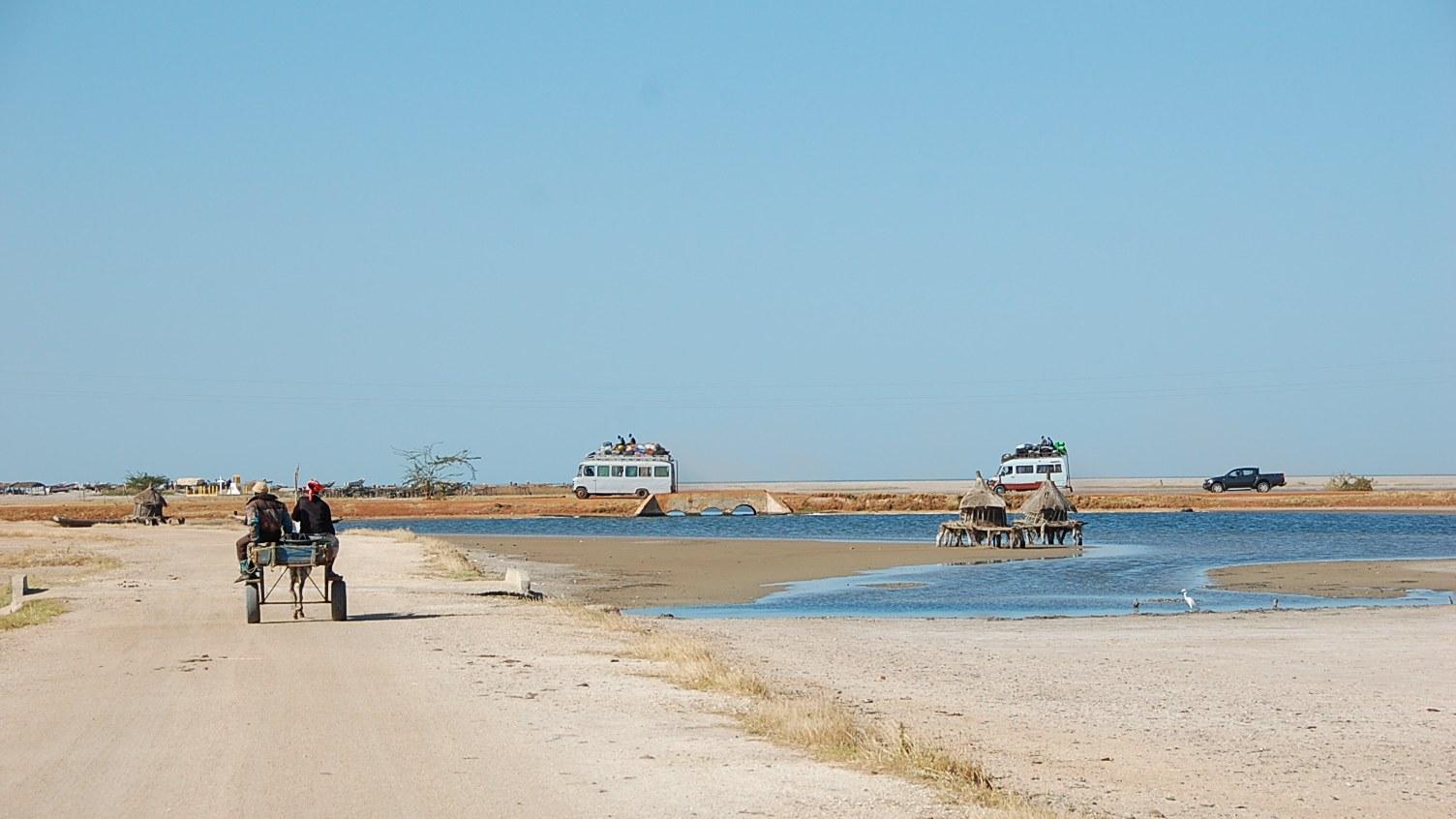
- On the road to Palmarin — An animal-drawn cart and minibuses on the road to Palmarin, beside a tidal lagoon with stilted granaries.
Explore on the map
Tap a pin to highlight its place card
All
1 spots
Recommended places
Gallery
1 · 1 selected
On the road to Palmarin
gallery
Related guides
Browse nearby destinations
Mar Lodj Guide
Fatick, Senegal
Car-free island village in the Saloum Delta
Adrasan
Antalya, TR
A pine-backed bay where the days move slowly
Air Batang
Pahang, Malaysia
A car-free Tioman village for divers and walkers
Akyaka
Muğla, Türkiye
Azmak boats, kitesurf wind and wooden balconies
Aneityum Guide
Tafea, Vanuatu
Beaches, reef and quiet in Vanuatu's far south
Angastaco Guide
Salta, Argentina
Torrontés wine and red hills in Salta's Calchaquí valley

Save these places to your list
Copy the spots you picked into your list — maps and notes included.