
Sifnos Guide
Cycladic walking island, and an August village feast
3 selected
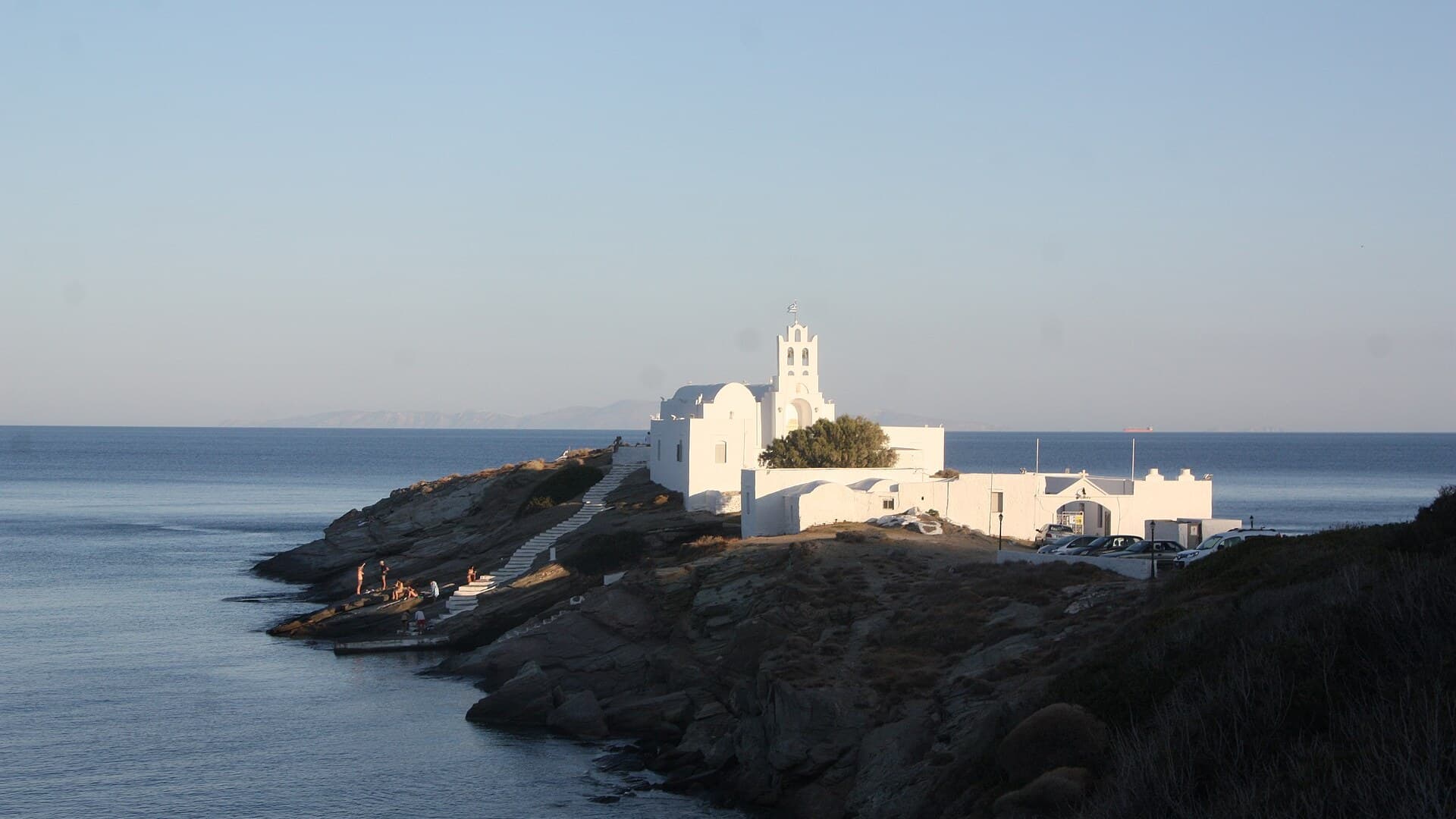
Sifnos is an island municipality in the western Cyclades, South Aegean, inside the Milos Regional Unit. It sits between Serifos and Milos, west of Paros, about 130 kilometres or 80 nautical miles from Piraeus. The island covers about 74 square kilometres, roughly 15 kilometres long and 7.5 wide, with about 70 kilometres of shore. The 2021 census counts 2,777 year-round residents. Treat the island as a few thousand people in winter, not a city. It lies near 36.97 N, 24.71 E. Postcode 840 03. The high point is Profitis Ilias, 682 metres.
Apollonia, inland, has been the capital since 1836. The 2021 figure for that town is 918. Artemonas sits higher on the same hill. Kastro, on the east cliff, was the capital until 1836 and still holds the archaeological museum. The ferry door is Kamares, a west-coast bay. Those are villages that run into one another, not districts of a town.
People who actually use Sifnos come to walk, and in late summer to stand in a village feast. The marked trail network is one of the larger systems in the Aegean, more than 100 kilometres, with red and white waymarks. Numbered routes run from a short northern walk to a 15 kilometre day. July and August are too hot in the middle of the day, with little shade. If you came for the feast, walk at dawn or after the heat breaks. Do not treat midday August as hiking weather.
The feast itself is a panigiri: a saint-day gathering at a church or monastery, food from a communal pot, music that runs late. That is ordinary Greek island practice. Chrisopigi, on a small east-coast peninsula, is the island’s main religious site. 15 August is the Dormition everywhere the Orthodox calendar runs. Village days move. Check the municipal notice the week you travel. Do not invent a private August programme from a blog.
One long day from the ferry covers Kamares and the Apollonia to Artemonas hill if the bus is running. Two days add Kastro or a short marked trail. Three or four days are the stay that fits the ground if you walk early and sit out noon. A full week only earns its keep if you came to walk daily and accept that August afternoons are for shade, a cove, or a feast, not a schedule. Nightlife as a city would mean it, a week of museums, a desk with all-day power: look at Athens or Syros. Families who want a long sand beach use Platys Gialos and then complain about the crowd. Couples who want a harbour evening can have Kamares, then find it is still a ferry quay.
The hiking and the August feast: yes. A cool walking week in August: no. A fly-and-flop resort that happens to be quiet: no. You do not need a car to cross the central villages. A car helps for Vathi, Cheronisos, and the south coves when the bus thins. In August the fast boats from Piraeus sell out on weekends. Buy the ticket before you arrive at the quay.
Do not confuse this Sifnos with a mainland village of a similar name. This guide is the Cycladic island, postcode 840 03.
How a mining island became a walking island
People have lived on Sifnos since at least 4000 BCE. The island sat in the Late Neolithic and Early Bronze Age Cycladic world. Gold, silver and lead made it rich by the third millennium BCE. In the sixth century BCE the Siphnians built a treasury at Delphi for their offerings. Pausanias wrote that the mines later flooded. Modern writing treats that as workings driven below sea level, or as veins that ran out. Remains still show at Ayios Sostis. Kastro held the capital into the modern Greek state. Apollonia took that role in 1836. The west stayed the ferry side: bare, steep, Kamares in the bay. The east is the greener slope most visitors walk. Pottery became the craft that outlived the mines. Pottery exports peaked in the nineteenth century, then Siphnian potters carried the trade to other islands and to Marousi in Athens. Nikos Tselementes, the cookbook name most Greeks still use as a synonym for a recipe book, came from the village of Exambela. The island never became a city. It became a municipality with a winter count in the low thousands and a summer that multiplies the beds. That is the history you walk through: terrace walls, a medieval cliff town, a ferry quay that did not exist as a resort.
Eating on Sifnos
Sifnos has a cooking name in Greece that is larger than the island. Tselementes is the reason, and the clay pots are the reason under that. Local cooking names mastelo, a dish cooked in the pot of the same name, and revithada, the chickpea bake. Chickpea soup still turns up as a Sunday pot. Capers with their leaves, thyme honey, manoura and myzithra cheeses, pasteli: those are the island products, not a dining map. Kitchens cluster in August around Kamares, Apollonia and the south beaches, then thin when the boats empty. A Tuesday in February is a poor night to arrive hungry and expect a choice of rooms. If you walk the long trails, take water and food. There is no shade you can count on at noon. Do not build the day around a named table. This guide does not list rooms.
How to get to Sifnos
There is no airport on Sifnos. The door is the ferry into Kamares. In high season daily or almost daily ships run from Piraeus: about five hours on a conventional ferry, about half that on a fast catamaran. Weekend fast boats fill. Buy before you stand on the quay. A second air route goes through Milos: fly there, then take the island ferry across. The regular line runs Piraeus to Kythnos to Serifos to Sifnos to Milos to Kimolos, with other Cycladic calls less often. Check the operator the week you travel. Do not treat a blog timetable as a clock. Athens International is the usual long-haul airport, then the metro or suburban rail and a taxi or bus to the Piraeus gates. Leave margin. A missed boat is a night in Piraeus, not a later train. From other islands the useful neighbours are Serifos and Milos. Paros is close on the map and less often on the ticket. There is no useful passenger airfield on Sifnos itself. Do not plan an arrival around a private strip.
Moving around Sifnos
In summer the bus is the useful network: from Kamares toward most villages every hour or two, taxis on a fixed island tariff when they have not already filled at the ferry. The walk from Apollonia to Artemonas is steep and about twenty minutes. Kastro is a bus, or about three kilometres on a path with little shade. You do not need a metro. There is none. The marked trails are how you leave the road. They connect villages to coves and to sites you only see on foot. In August start early. Carry more water than looks polite. The official trail pages ask you not to walk through the hot hours. A hired car or scooter helps for Cheronisos and the south when the last bus has gone. Parking in Apollonia in August is a hunt, not a plan. If hills, heat, or loose stone are a problem, the central pair of villages is already work. The quay at Kamares is the flat ground. The rest of Sifnos is a terrace.
Money and staying connected
Greece pays in euros. Cards work in the summer towns. A small bakery in February may still want cash. Nobody publishes a Sifnos daily budget. August beds on a walking island are the expensive shape. A shoulder-season room and a packed lunch is the cheaper one. ATMs sit in Apollonia, near the banks there. Do not arrive on a Sunday in November counting on a working machine at the quay. Plugs are Type C and Type F, 230 V. Emergency number 112. Postcode 840 03. eSIM and EU roaming behave as they do in the rest of Greece. Café Wi-Fi is not an office. Download an offline map for the trails before Piraeus. A terrace path is a poor place to learn that the signal has dropped and you never saved the GPX. Tap water on Greek islands is a local question. Carry a bottle on the walk either way.
Weather, manners, and what goes wrong
July and August are hot, dry, and full. The trail pages tell you not to walk through the middle of the day. June and September keep the boats and lose some of the crush. Winter is the island as a municipality: wind, shutters, a timetable that thins to a few ships a week. Rain is possible in the cold months. The sea is the Aegean, not a pool. Churches and monasteries are working rooms. Cover shoulders at Chrisopigi. A panigiri is a village night, not a ticketed show. Eat what is offered, pay if a plate is priced, leave when the family is done with you. People live on this hill all year. Keep the lane quiet after midnight except on the feast itself. The usual errors: arriving in August without a ferry ticket. Starting a 15 kilometre route at 11.00. Treating Kamares as the place to stay a week. Expecting Mykonos after dark. Mixing the island with a mainland namesake. Flying a drone over a church yard. Violent crime is not the story the sources tell. Heat, a missed boat, a dry bottle on a terrace, and a path with no shade are. Swim with a margin. The port is a working quay. Postal code 840 03.
FAQ
What is covered in the Sifnos guide?
Sifnos in the Cyclades: marked trails, August heat, the village panigiri, and the ferry into Kamares. It includes 3 recommendations across 2 hotels, 1 gallery.
Next →How many places are in the Sifnos guide?
The Sifnos guide lists 3 places: 2 hotels, 1 gallery.
Next →Where is Sifnos?
Sifnos is in South Aegean, Greece (36.9714, 24.7081).
Next →How do you get to Sifnos?
There is no airport on Sifnos. The door is the ferry into Kamares. In high season daily or almost daily ships run from Piraeus: about five hours on a conventional ferry, about half that on a fast catamaran. Weekend fast boats fill. Buy before you stand on the quay. A second air route goes through Milos: fly there, t…
Next →What should you eat in Sifnos?
Sifnos has a cooking name in Greece that is larger than the island. Tselementes is the reason, and the clay pots are the reason under that. Local cooking names mastelo, a dish cooked in the pot of the same name, and revithada, the chickpea bake. Chickpea soup still turns up as a Sunday pot. Capers with their leaves,…
Next →Is there camping in Sifnos?
No camping listings in this pack yet — we do not invent venues. Entries will appear once verified.
Next →Can you rent a bike in Sifnos?
No bike rental listings in this pack yet. Verified shops will be added when available.
Next →What are recommended hotels in Sifnos?
Highlighted hotels in the Sifnos guide: Ktima Edem; Sigma Residences.
Next →Highlighted places
- Sifnos — Western Cyclades island municipality, South Aegean.
- Ktima Edem — The accommodation is designed to meet the needs of guests traveling for leisure or business. Internet access in public areas allows guests to stay connected during their stay.…
- Sigma Residences — Sigma Residences offers amenities such as baggage storage, a safe, car hire, and laundry services. Guests can stay connected with wireless internet access in public areas. Additionally, there…
Explore on the map
Tap a pin to highlight its place card
All
1 spots
Recommended places
Hotels
2 · 2 selected
- hotels
Ktima Edem
Ktima Edem offers accommodation in Sifnos, providing quality services and a range of amenities for its guests.
- hotels
Sigma Residences
Sigma Residences welcomes guests in Sifnos, offering a comfortable stay with a range of services.
Gallery
1 · 1 selected
Sifnos
gallery
Related guides
Browse nearby destinations
Serifos Guide
South Aegean, Greece
Small western Cycladic hop, not Milos and not Ios
Adrasan
Antalya, TR
A long bay south of Antalya, quieter than the big resort towns
Air Batang
Pahang, Malaysia
A west-coast dive village on Tioman, not Tekek and not Juara
Akyaka
Muğla, Türkiye
A Cittaslow village at the eastern end of Gökova Bay
Aralsk Guide
Kyzylorda, Kazakhstan
Former Aral Sea port in Kyzylorda Region, now a rail stop on dry ground
Atouguia da Baleia
Leiria, Portugal
Older Peniche parish: church, castle scraps, Consolação on the sand

Save these places to your list
Copy the spots you picked into your list — maps and notes included.