
Plomin Guide
Stone lanes and sea views above Plomin Bay
1 selected
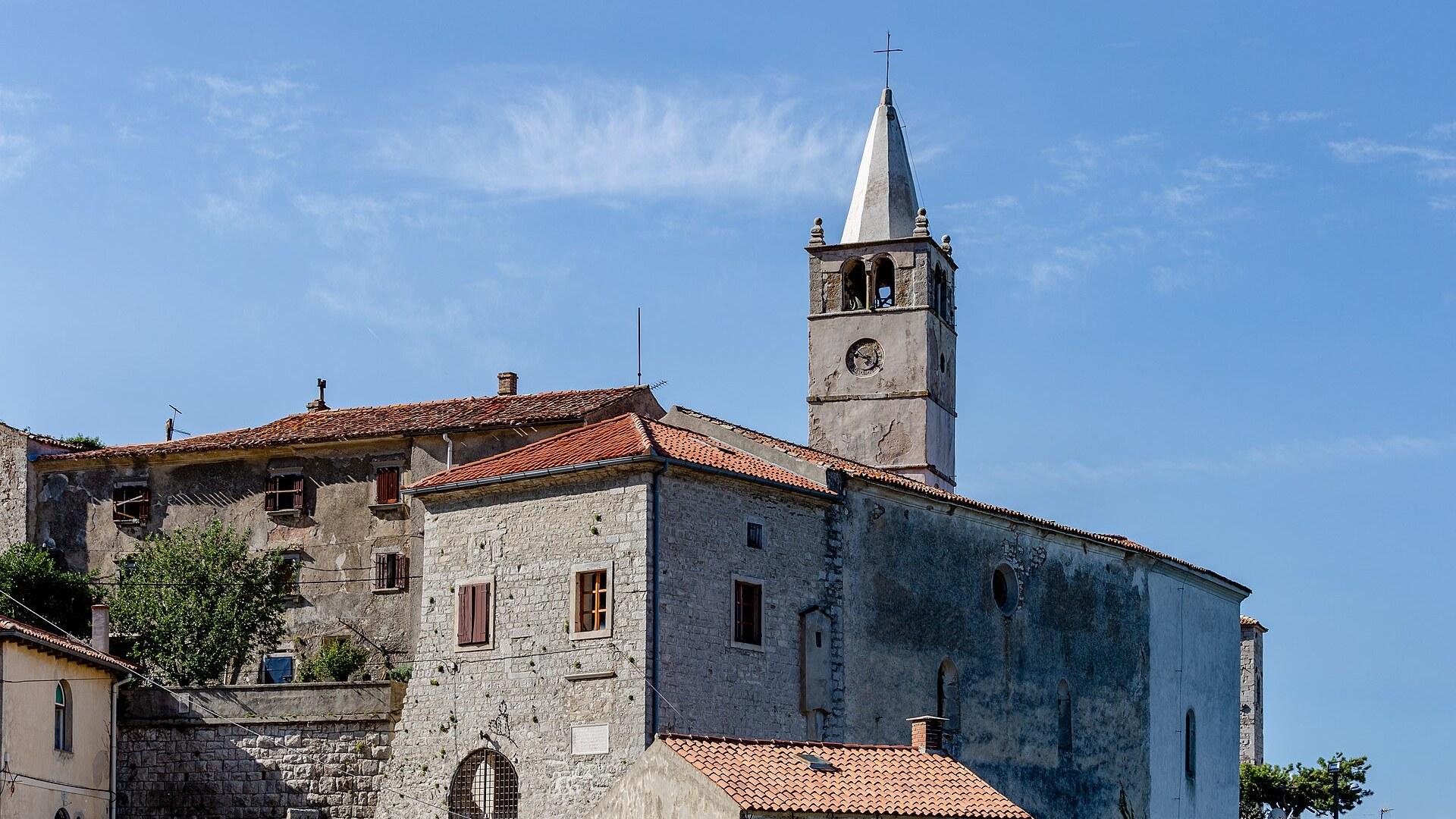
Plomin sits on a hill in Istria County, Croatia, about 11 km north of Labin, and its old town looks down on the bay that gave the village its name. You see it from the road before you arrive: stone houses and walls on the ridge, with the thermal power station of Plomin close by as a less romantic neighbour. Most people stop for an hour, and that is about right.
Italian-speaking families made up most of the village until after World War II, which is why Plomin has a second name, Fianona. Today the old town feels more like a place to wander than a place to do things, and that suits it.
Inside the walls the lanes are narrow and many of them run under arches. Old writings and crests are set into the stone, and purple flowers push out of the wall joints. Several houses are ruins, some only roughly propped up, so you wander more than you tour. Resettlement has started on a small scale, but the village is mostly deserted, which is why it feels quiet and peaceful.
Two things are worth looking for. Tura, an 18th-century Venetian town palace, houses a lapidary with finds from Roman times. Nearby, a sculptor's workshop and garden, signposted Sculptures, shows wooden artworks and antique tools from the region, and more sculptures stand around the ruins.
The views make the walk up worth it. On one side the sea and Kvarner Bay open out, on the other a valley drops away below the walls. From the old town you can also pick out Plomin Luka, the village on the bay below, which gives you a sense of how close the water once was.
A busy road runs right beside the old town, and one visitor found the traffic noise disturbing, especially at sunset. Keep that in mind if you plan to sit on the walls for the evening light. Buses can also fill the parking lot, so the old town is calmer when the road is quiet.
Allow about 1 h on foot for all of it. One traveller treated it as a 20 to 30 min break on a drive through Istria, and that works too. If you hope to swim afterwards, remember that the Istrian coast is crowded in the high season and has numerous beaches without sand.
From Roman Flanona to a Venetian fortress on the bay
Plomin began as Flanona, a settlement of the Illyrian Liburnians that the Romans later built up above the bay of the same name. In Roman times it became an important base for seafaring in the Adriatic and belonged to the westernmost part of the province of Dalmatia. The houses you pass today are several hundred years old and stand on the ruins of the original Roman ones, while the town walls date back to the 9th century. From the 10th century the Republic of Venice held the town. In the 15th and 16th centuries it was one of the most important Venetian fortresses along the coast, though Venice's conflicts with Austria in the 16th and 17th centuries destroyed parts of it. After that its importance slowly waned. Two churches carry most of the story. Sv. Juraj Stari, St George the Elder, is Romanesque, and the relief of the god Silvanus can be seen on its south side. In its outer wall sits the Plomin tablet, an 11th-century text in the Glagolitic alphabet, the oldest known Slavic alphabet. Sv. Juraj Mlađi, St George the Younger, is a late Gothic parish church with a 1475 fresco by the Konstanz painter Albert showing the nursing Madonna. The end came after World War II. The bay silted up and became too muddy, and the mostly Italian inhabitants emigrated to Italy, so the old town emptied. Many buildings fell into disrepair and were only roughly secured against collapse, and the village has since been repopulated bit by bit. Read the old writings and crests on the walls as you go, and look in at the Tura palace for its Roman finds.
Eating near Plomin: pasta, truffles and Istrian jota
Food in Plomin itself is limited to a restaurant opposite the old town and a pizzeria for a drink or a snack. Treat the hill as a stop between meals rather than a destination for one, because a roadside restaurant was found closed on one visit. The wider region makes up for it. Istrian cooking leans on pasta, gnocchi, risotto and polenta, with fresh fish and seafood on the coast and air-cured ham (prsut) and sausages inland. Jota is made from sauerkraut and beans, without potatoes, and comes with white or yellow polenta. Fritaja is the typical Istrian egg dish, and you will find it on plenty of menus. Autumn changes what is on the table. The truffle season begins in late September, and pasta with truffles and truffle olive oil are typical. If you arrive after that, look for them on the menu of whichever Istrian town you stop in next. For simpler food, go to a market. Istrian vegetables can be bought cheaply at open-air markets in almost every Istrian town, so a bag of produce makes an easy lunch after the walk through the old town. A good rhythm is to walk the old town first, which takes about 1 h, and then eat at the restaurant opposite. Seafood belongs to the coast and ham and sausages to the inland villages, so what lands on your plate changes as soon as you leave the bay and drive up into the hills.
Reaching Plomin by car along the road to Labin
Plomin is easiest to reach by car, since it lies along the road to Labin, about 11 km north of the town, and the old town can be seen from the road as you drive there. It is a popular stop for tourists traveling through Istria by road. The last 1000 m up to the old town are somewhat tricky to drive, and only a few parking spaces are available. The parking lot at the old town can also be blocked by buses, so be ready to wait for a space. A busy road runs right beside the old town, which is worth knowing when you slow down to look for a place to stop. Trains will not bring you to the door. The rail stations near Plomin are Kršan, Pazin, Cerovlje and Raša, and Plomin belongs to the municipality of Kršan, so Kršan is the one to look at first. From any of them you would still have to cover the last stretch by road. Because the village sits on the Labin road, it combines well with a day in Labin or a longer drive through the region. Parking is the bottleneck, not the distance, so a quiet hour makes the whole stop easier. Plan about 1 h on foot once you have parked, and arrive early if you want the parking lot and the lanes to yourself.
Walking Plomin old town and looking down to Plomin Luka
Plomin old town is made for walking, and a full round through the lanes takes about 1 h. Once you have parked, the car stays where it is: everything worth seeing sits behind the walls. The streets are narrow, built of stone and often covered by arches, so wear shoes with a good grip. Some houses are ruined and only roughly secured against collapse, which is a reason to keep to the lanes instead of stepping into the ruins. Along the way, follow the sign for Sculptures. It leads to a sculptor's workshop and garden with wooden artworks and antique tools from the region, and more sculptures are set around the ruins. Tura, the 18th-century Venetian palace, and the two churches of St George are within the same walls, so you cover them without any transport. From the old town you can see Plomin Luka, the village on the bay below. The busy road beside the old town is the only real hazard, so watch the traffic when you step out toward the viewpoints. Short on time? One traveller used 20 to 30 min as a break and still saw the main lanes, though the full walk is better. Walk slowly. The old writings and crests on the walls, the arches over the lanes and the purple flowers growing from the stones are easy to miss at speed. End on the side of the walls that looks over the sea, since that is where Kvarner Bay opens up, and the village is quiet enough that you will mostly hear your own steps.
Spending, markets and languages around Plomin
Spending in Plomin stays small, because the village offers little beyond a restaurant opposite the old town and a pizzeria. Croatia uses the euro (€), and the larger shopping and eating happens in the towns of Istria. For everyday buying, the open-air markets are your best bet. Istrian vegetables can be bought cheaply at open-air markets in almost every Istrian town, so fill a bag there before or after you visit the hill instead of looking for shops in the village. Language will rarely be a problem. Croatian is the official language of Istria, but Italian is nearly universally understood and German is also very widely spoken. A few words of Italian go a long way with older residents. Because the old town is mostly deserted and very quiet, the only sounds you will compete with are those of the road. Use the stop as a break from screens as well: the lanes, arches and views over Kvarner Bay deserve your attention more than a phone does. Plomin is called Fianona in Italian, and that Italian layer explains why the language is so useful here: the mostly Italian inhabitants emigrated to Italy only after World War II. Croatian is the official language, but a few polite words in Italian or German go a long way at the pizzeria or the restaurant opposite the old town.
Plomin practical questions: noise, time, parking and food
A few answers will save you guesswork on the hill above Plomin Bay. How long should you plan for the old town? About 1 h of walking covers it, which is enough for the lanes, the views and a look at the churches. One traveller called it great for a 20 to 30 min break. When is the best time to go? Labin has a mean daily maximum of 27 degrees C in July and August and 8 degrees C in January and February. The coast is crowded in high season, but the village itself is mostly deserted. Late September brings the start of the truffle season. Since many Istrian beaches have no sand, do not count on it for a swim. Is the old town noisy? A busy road runs right beside it, and one visitor found the traffic noise disturbing, especially at sunset. The lanes inside the walls are far quieter, so plan your sunset spot with the road in mind. Is parking easy? Not always. The last 1000 m are somewhat tricky to drive, only a few spaces exist, and buses can block the parking lot. If it is full, wait a while or come back at another hour. Where can you eat? There is a restaurant opposite the old town and a pizzeria for a drink or a snack. A roadside restaurant was closed on one visit, so do not count on it. Which language works best? A few Italian words will help. Croatian is official, but Italian is nearly universally understood and German is very widely spoken.
FAQ
What is covered in the Plomin guide?
Discover Plomin in Istria County: arched stone lanes, two St George churches and sea views, 11 km north of Labin. Plan a quiet hour on the hill. It includes 1 recommendations across 1 gallery.
Next →How many places are in the Plomin guide?
The Plomin guide lists 1 places: 1 gallery.
Next →Where is Plomin?
Plomin is in Plomin, Istria County, Croatia (45.1379, 14.1808).
Next →How do you get to Plomin?
Plomin is easiest to reach by car, since it lies along the road to Labin, about 11 km north of the town, and the old town can be seen from the road as you drive there. It is a popular stop for tourists traveling through Istria by road. The last 1000 m up to the old town are somewhat tricky to drive, and only a few…
Next →What should you eat in Plomin?
Food in Plomin itself is limited to a restaurant opposite the old town and a pizzeria for a drink or a snack. Treat the hill as a stop between meals rather than a destination for one, because a roadside restaurant was found closed on one visit. The wider region makes up for it. Istrian cooking leans on pasta, gnocc…
Next →Is there camping in Plomin?
No camping listings in this pack yet — we do not invent venues. Entries will appear once verified.
Next →Can you rent a bike in Plomin?
No bike rental listings in this pack yet. Verified shops will be added when available.
Next →What are recommended gallery in Plomin?
Highlighted gallery in the Plomin guide: The old town of Plomin.
Next →Highlighted places
- The old town of Plomin — Stone houses and the church bell tower of the hilltop village of Plomin in Istria, Croatia.
Explore on the map
Tap a pin to highlight its place card
All
1 spots
Recommended places
Gallery
1 · 1 selected
The old town of Plomin
gallery
Related guides
Browse nearby destinations
Adrasan
Antalya, TR
A pine-backed bay where the days move slowly
Air Batang
Pahang, Malaysia
A car-free Tioman village for divers and walkers
Akyaka
Muğla, Türkiye
Azmak boats, kitesurf wind and wooden balconies
Aralsk Guide
Kyzylorda, Kazakhstan
The sea left, the ships stayed
Atouguia da Baleia
Leiria, Portugal
A village named for whales, minutes from the Atlantic
Auray Guide
Brittany, France
Two towns on one river, joined by a stone bridge

Save these places to your list
Copy the spots you picked into your list — maps and notes included.