
Larmor-Baden Guide
Boats to Gavrinis, a tidal island and oysters at the port
1 selected
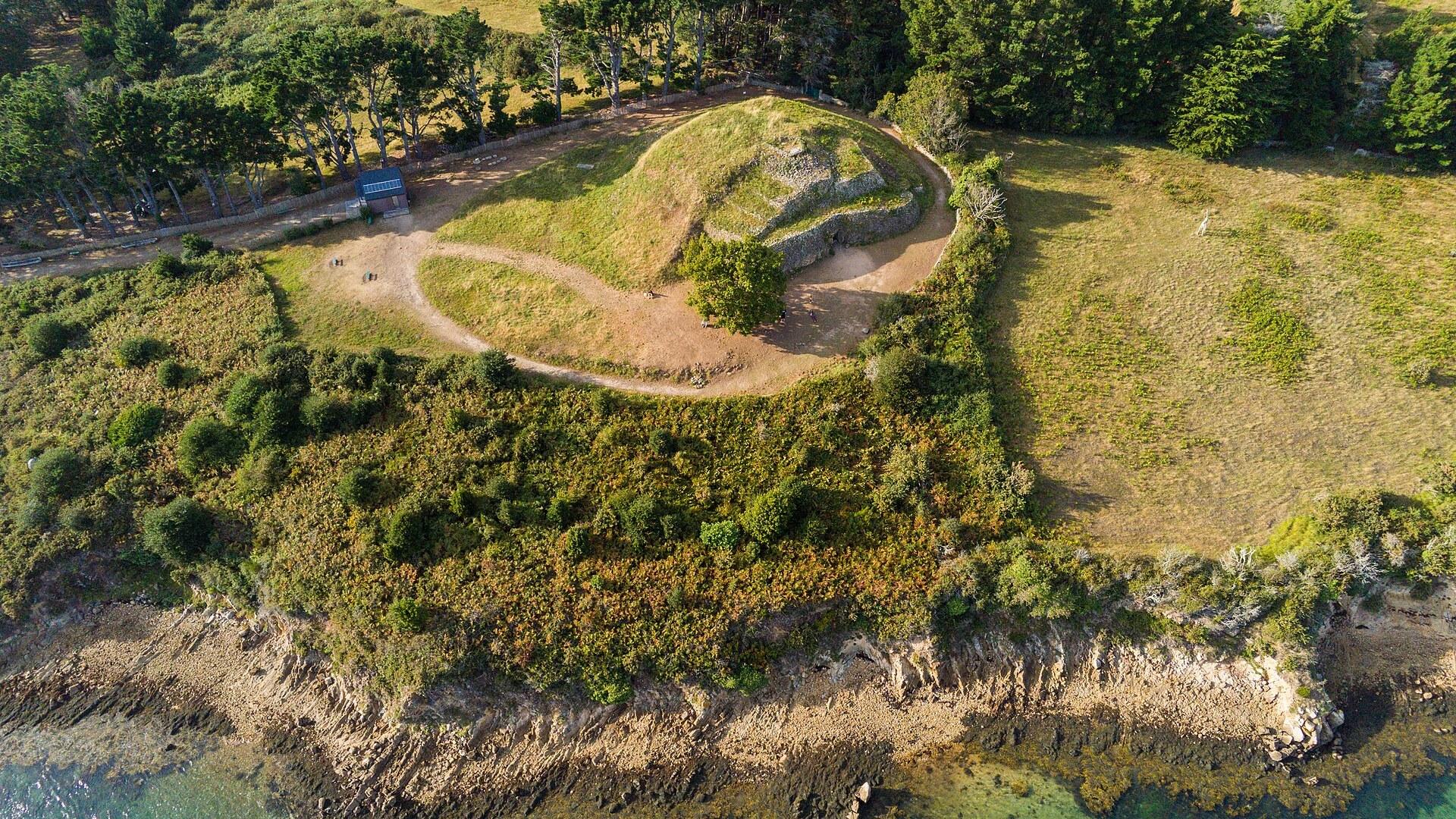
Larmor-Baden sits in Brittany, France, at the southern tip of a peninsula that pushes far into the Gulf of Morbihan. Nearly everything here faces the water, and most people come for one thing: the boat to Gavrinis, a small island with a carved Neolithic tomb. Everything else in Larmor-Baden, from a tidal island to the port itself, fits around that trip.
The boats leave from the Pen Lannic slipway at the port, and the crossing takes about 15 min. Visitors describe a very strong current each way. On the return the boat circles the island, passes prehistoric features and now and then gives a glimpse of submerged megaliths. One visitor suggests adding a pass by Er Lannic, an islet with two horseshoe-shaped alignments of menhirs that the sea partly covers.
Île de Berder is the other obvious outing. It lies just off the village and is joined to the mainland by submerged land that only shows at low tide, so the tide decides when you can walk over. Visitors mention ancient trees, a manor, a tower and views across the gulf and its strong currents. The name comes from the Breton word Breudeur, which means brothers.
Back in the village, the church of Notre-Dame keeps local ex-votos, among them a statue of Notre-Dame de Larmor holding a three-master in her left hand, her right hand resting on an anchor. Outside the centre, Le Douet de Locqueltas, about 1.5 km northeast, has two wells and a wash-house in a meadow near two thatched farms. Le Marais de Pen en Toul, a marsh and bird reserve, lies about 2 km northeast.
On the water you can book a day or half-day sea trip on Mod Koz, a racing catamaran based in the port, or a fishing trip with Guidage Pêche Morbihan. A visitor to the catamaran advises bringing water, a hat, sunglasses and sunscreen. Larmor-Baden once had a small fishing harbour, and the village and its surroundings are still regarded as good places for anglers.
For a swim, Plage de Locmiquel is the beach listed for Larmor-Baden. One visitor reported jellyfish there, with a couple stung several times, so look at the water before you get in. The long sandy beaches lie further along the coast, around Locmariaquer, Saint-Philibert, La Trinité-sur-Mer and Carnac.
Six thousand years of carved stone near Larmor-Baden
Larmor-Baden's story begins in the Neolithic, when the Gulf of Morbihan was an important place for megalith builders and the passage tomb on Gavrinis was built around 4200 to 4000 BC. Many older menhirs in the gulf were toppled around 4200 BC, and their pieces were reused as capstones in dolmens. Larmor-Baden has a Neolithic dolmen of its own, covered by a tumulus and recognised as a Monument historique in 1960. Gavrinis is the main event. The cairn is about 50 m across, and a passage of roughly 14 m leads inside. About 29 upright slabs line it, 23 of them carved with axes, zigzags and horn-like motifs. Its nickname is the Sistine Chapel of the Neolithic, and one description gives a height of 6 m. Accounts of the corridor differ: another visitor measures it at 15 by 3 m and adds that the lighting makes the designs hard to make out. Visitors compare the carvings with Newgrange in Ireland. Seen together with Carnac, whose menhirs have stood for 7,000 years, and nearby Locmariaquer, Gavrinis gives a strong feel for Neolithic culture. Er Lannic, the islet with its half-drowned horseshoe alignments, belongs to the same landscape. If you have a spare day, pair Gavrinis with one of those two. The later story is shorter. In the Middle Ages Larmor belonged to the village of Baden and became a separate commune only in 1857. The neo-Romanesque church of Notre-Dame was consecrated in 1880; look up at the west façade for its bell gable, a rarity in northern France. Since the 1960s, sailing tourism has grown in importance around Larmor-Baden.
Oysters at the port of Larmor-Baden
Food in Larmor-Baden means oysters, which have been farmed in the Gulf of Morbihan since the end of the 19th century and are served right at the port. One visitor's tip is to eat very fresh oysters after the Gavrinis trip at the tasting bar Chez Lucien, next to the Tourism Office. About 20 small oyster businesses still exist in the gulf. They switched to Japanese and Pacific oysters after the oyster crisis of 1973/74, and those are the kinds the farms work with today. So when you taste oysters here, you are tasting a trade that has changed a lot in fifty years. The boats to Gavrinis leave from the same spot, so the order of the day writes itself: tour first, oysters after. If you would rather catch your own, a fishing guide aboard the Bleiz Mor works the coast from Sarzeau up to Houat, Hoedic and the gulf. Visitors time the outing differently, from about 90 min to 2h30 including the boat tour, so leave a generous gap before you plan a table anywhere else. The longer Gavrinis tour from Vannes includes a short lunch stop in Larmor-Baden, which means you may share the quay with people who arrived by water. If oysters are not enough, a nature guide in the regional natural park of the Gulf of Morbihan offers edible seaweed tastings all year round.
By road from Auray or Vannes, or by boat from Vannes
Larmor-Baden lies at the southern tip of a peninsula, about 13 km by road southeast of Auray and about 15 km southwest of Vannes. Those two towns are the points to measure the trip from, and one forum reviewer calls Gavrinis the most worthwhile visit among the islands of the Gulf of Morbihan while believing that the boat needs to be reserved. Because the village sits at the very end of the peninsula, you reach it by following the land until it runs out at the water. A second way in is by boat. A longer Gavrinis tour leaves from Vannes, with 1 h 15 min of sailing each way and a short stop in Larmor-Baden for lunch. That is a full outing rather than a transfer, so it suits you if the boat ride itself is what you came for. Plan the arrival around your Gavrinis slot, not the other way round. The visit is guided and capped, and the crossing starts at the Pen Lannic slipway, so give yourself time to park and to swap your ticket before the boat leaves. Larmor-Baden also works as one stop on a longer loop. Locmariaquer, Saint-Philibert, La Trinité-sur-Mer, Carnac and the Quiberon peninsula all lie nearby, with sandy beaches and yacht harbours. France.fr suggests pairing Gavrinis with Suscinio Castle on the Rhuys peninsula, a residence of the Dukes of Brittany where children can try crossbow shooting.
Port, slipway and parking in Larmor-Baden
Getting around Larmor-Baden mostly means getting to the port, where the Tourism Office stands and the Gavrinis boats leave from the same point. The crossing itself takes about 15 min, so the trip is short once you are on board. The awkward part is parking. One visitor found it a challenge near the departure but did get a street spot not too far away, and another notes that the operator's website has a parking map. Look at that map before you set off, and leave time to park before your boat. On the island, you arrive at a visitor centre with explanatory panels, and the part beyond the fence stays in private hands, so your route follows the guide. Bags and backpacks go into a locker on the island, which means you carry only what you need inside. Île de Berder is joined to the mainland by a short causeway, so check the tide times before you head over. Your boat back from Gavrinis passes other prehistoric features on its way round the island, which saves a separate trip for the views. Plage de Locmiquel is listed with the church of Notre-Dame and the Musée des Passions et des Ailes among the nearby sights, so those three can be treated as neighbours. The Tourism Office also books Gavrinis tickets, which makes one stop on the quay enough for information, tickets and the boat.
Paying for Gavrinis: euros, online tickets and your phone
Money in Larmor-Baden is in euros, and the one thing worth paying for ahead is the Gavrinis visit. Tickets can be bought online in English or booked at the Tourism Office at the port, so you can choose between a screen and a counter. Accounts differ on how the ticket reaches you. One visitor collected tickets at a small shop, while others swapped an online ticket at the reception building on the quay for a boarding pass that covers both the boat and the cairn. Arrive a little early so a queue at that building does not eat into your slot. Because booking is online and the operator's website also carries a parking map, a phone with mobile data is useful before you leave home and on the way to the port. Keep your confirmation where you can open it quickly, since the boarding pass is exchanged on the quay. Visitors report that Gavrinis seats are booked on average 14 days ahead, so the payment step is usually something you do weeks before the trip rather than at the port. Tickets in English do not guarantee a tour in English, since the tours are often in French. Treat the Tourism Office as your fallback for questions and bookings, not as a place to count on for a last-minute seat.
Booking Gavrinis, group sizes and what to bring
Nearly every practical question in Larmor-Baden comes back to Gavrinis, because the visit is guided and the number of places is limited. Visitors' accounts differ on several details, so read the numbers below as a range. How early should I book Gavrinis? Seats are booked 14 days ahead on average, and one visitor says weekend seats are scarce and advises planning more than 2 days in advance. To be in the first group inside and wait less, choose the very first slot of the day or the first one in the afternoon, at 14:30. How long does the visit take? Accounts differ: a 15 min crossing plus a 90 min guided tour, 2h30 for the whole outing including the boat tour, or about 1.5 h from the port. Plan on the longer figure if you have something booked afterwards. How many people go in at once? The boat takes a maximum of 25 people. Inside, reports differ: groups of 4 or 5 for about 5 min, subgroups of 10 or fewer from a tour of about 20, or only about 8 people at a time. What should I bring, and can I take photos? Bring a flashlight, because visitors found phone flashlight apps too weak, and children enjoyed visiting with one. Photography is not allowed in the passage, though one visitor says the guide did not police the rule. Will the tour be in English? The tours are often in French, but some guides give English explanations to English speakers, one visitor took a tour guided in English, and another mentions a brochure in their own language. Is there anything to watch for when swimming? A visitor reported jellyfish at Plage de Locmiquel, with a couple stung several times. Look at the water before you get in.
FAQ
What is covered in the Larmor-Baden guide?
Plan your visit to Larmor-Baden in Brittany: the boat to the Gavrinis cairn, Île de Berder at low tide, oysters at the port and how to book ahead. It includes 1 recommendations across 1 gallery.
Next →How many places are in the Larmor-Baden guide?
The Larmor-Baden guide lists 1 places: 1 gallery.
Next →Where is Larmor-Baden?
Larmor-Baden is in Larmor-Baden, Brittany, France (47.5878, -2.8958).
Next →How do you get to Larmor-Baden?
Larmor-Baden lies at the southern tip of a peninsula, about 13 km by road southeast of Auray and about 15 km southwest of Vannes. Those two towns are the points to measure the trip from, and one forum reviewer calls Gavrinis the most worthwhile visit among the islands of the Gulf of Morbihan while believing that the…
Next →What should you eat in Larmor-Baden?
Food in Larmor-Baden means oysters, which have been farmed in the Gulf of Morbihan since the end of the 19th century and are served right at the port. One visitor's tip is to eat very fresh oysters after the Gavrinis trip at the tasting bar Chez Lucien, next to the Tourism Office. About 20 small oyster businesses s…
Next →Is there camping in Larmor-Baden?
No camping listings in this pack yet — we do not invent venues. Entries will appear once verified.
Next →Can you rent a bike in Larmor-Baden?
No bike rental listings in this pack yet. Verified shops will be added when available.
Next →What are recommended gallery in Larmor-Baden?
Highlighted gallery in the Larmor-Baden guide: Cairn de Gavrinis.
Next →Highlighted places
- Cairn de Gavrinis — The Gavrinis cairn, reached by boat from Larmor-Baden, Gulf of Morbihan.
Explore on the map
Tap a pin to highlight its place card
All
1 spots
Recommended places
Gallery
1 · 1 selected
Cairn de Gavrinis
gallery
Related guides
Browse nearby destinations
Auray Guide
Brittany, France
Two towns on one river, joined by a stone bridge
Camaret-sur-Mer Guide
Brittany, France
Fishing harbour, tower and sea stacks at Brittany's western tip
Huelgoat Guide
Brittany, France
Mossy boulders, a rocking stone and a lake in Brittany
Locmariaquer Guide
Brittany, France
Megaliths, oysters and the mouth of the Gulf
Loguivy-de-la-Mer Guide
Brittany, France
A Breton fishing port that lives by the tides

Cap-d'Ail Guide
Alpes-Maritimes, France
The Riviera's quiet back door to Monaco

Save these places to your list
Copy the spots you picked into your list — maps and notes included.