
Kaub Guide
A toll castle afloat in the Rhine, and hardly any crowds
1 selected
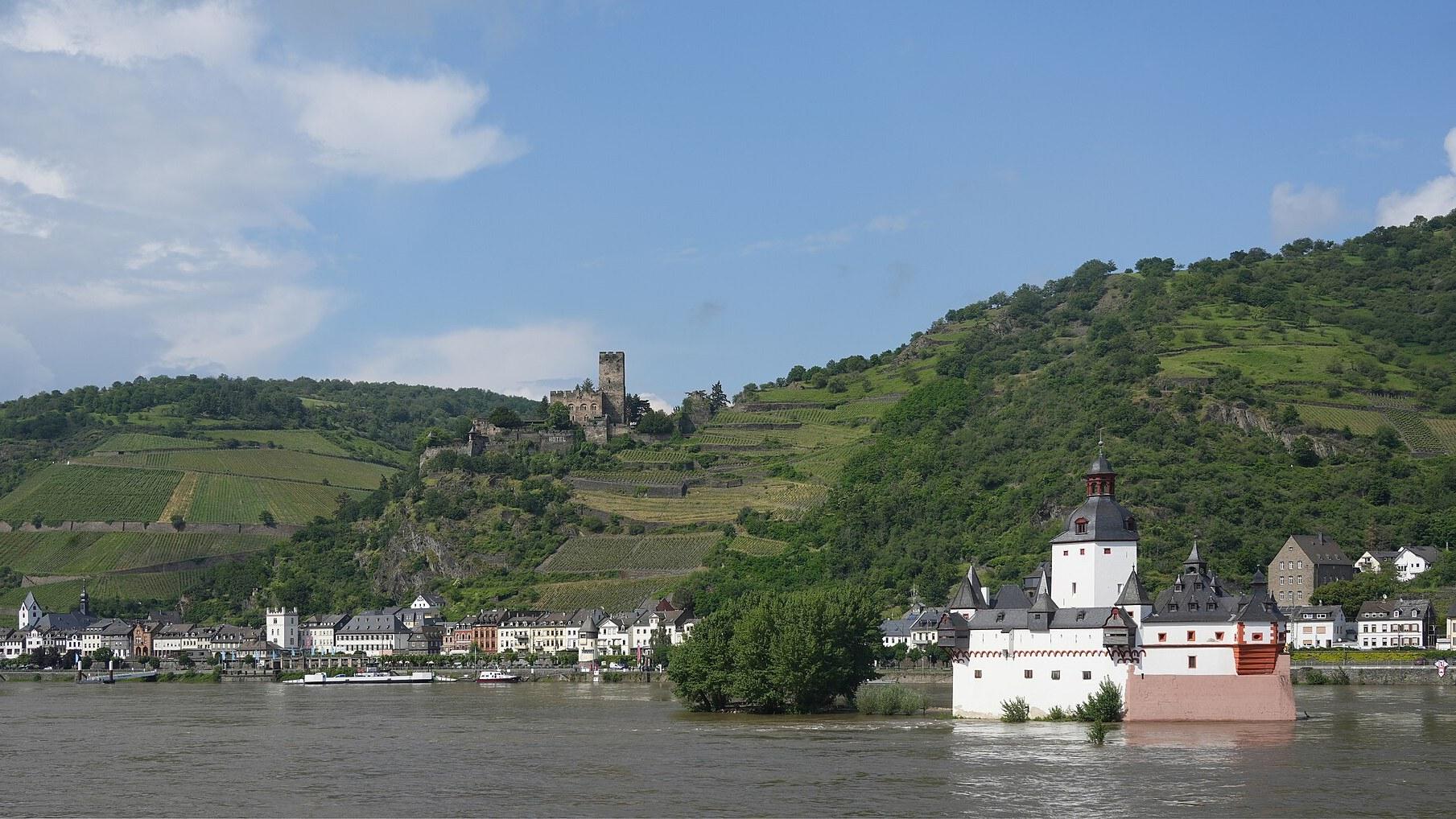
Kaub is a small town on the right bank of the Rhine in Rhineland-Palatinate, Germany, squeezed between the water and the steep slopes of the Rhenish Slate Mountains. It sits exactly halfway between Mainz and Koblenz, 46 km from each along the river. Most passenger ships do not stop here, so the town stays calm while the better-known stretches of the Middle Rhine fill up.
What you come for is Burg Pfalzgrafenstein, a castle on a rocky island in the middle of the river. Victor Hugo called it a stone ship, eternally floating on the Rhine and eternally anchored before the Palatinate town. A small passenger ferry runs out to it from Kaub. Inside it is rather bare, so you wander freely without a guide, past furniture from the 17th to 19th centuries and a 17th-century pizza oven on the second floor.
Take the stairs slowly, because they are steep and a bit tricky. Back on the bank, walk up to the vineyards south of Burg Gutenfels, where you get a fine view of the Rhine and the toll castle below. Gutenfels itself has been in private hands since 2006, so you can only walk around the outside.
In town, the Blücher Museum fills a villa furnished in the style of the early 19th century and tells how General Blücher crossed the Rhine here in 1813-14. A walkable stretch of the old town wall survives with five main towers still standing, so a loop through Kaub does not take long.
Walkers get the most out of the place. The Rheinsteig trail drops into the centre and climbs the other side of the Blüchertal, and from there you can walk on to the Loreley or to Lorch. The Rheingauer Riesling Pfad starts or ends in town, and across the river the Rheinburgenweg follows the left bank.
If you would rather be on the water, rafting trips down the Rhine leave from Kaub. One traveller called the guided tour very fun, with friendly guides who knew interesting facts about the surroundings. Between trips, the quiet riverbank is the real pleasure: with so few ships stopping, the Rhine traffic simply passes you by. Kaub is also home to the gauging station, a decisive measuring point for Rhine water levels, because the town lies at the shallowest part of the Middle Rhine.
Tolls, Sieges and Slate: How Kaub Lived off the Rhine
Kaub lived off the Rhine for centuries, through tolls, shipping and the wine from the slopes around it. The first written trace dates from 983, when a donation charter of Emperor Otto II mentions Cuba villula. Ludwig the Bavarian gave the settlement town rights in 1324, and since 2002 Kaub has been part of the UNESCO World Heritage Site Upper Middle Rhine Valley. Two years later the river itself became a business. In 1326/27 Ludwig had Burg Pfalzgrafenstein built on the island of Falkenau to collect tolls from passing ships. Its tower is pentagonal, so it splits waves and ice, and it rises 36 m over 6 storeys; a six-sided turreted wall followed around 1340. Chain booms were raised across the narrow channel, and ships that refused to pay were seized. The crew ended up in the dungeon, a wooden raft at the bottom of a well. The castle was never destroyed. Together with Kaub and Burg Gutenfels, built around 1220 on the hill above, it came through a 39-day siege by Landgrave William II of Hesse in 1504 unscathed. Gutenfels fared worse later: on Napoleon's orders it was partly demolished between 1805 and 1807, then rebuilt from 1889 to 1892. Pfalzgrafenstein got its baroque tower cap in 1714 and its present look after a fire in 1756. Tolls ended in 1867, a year after Prussia took over. Other chapters are easier to find on foot. The pilot station, once the largest on the Rhine, served until the mid-1980s and now houses the pilot museum. Slate was cut here from at least 1353, and abandoned pits still lie in the Kauber town forest, which makes a good walk. General Blücher crossed the river at Kaub in 1813-14, which the monument at the ferry landing recalls. And from 1919 to 1923 the town belonged to the Free State of Bottleneck, a small state the Allies never occupied.
Eating in Kaub: Deutsches Haus, the Baker and the Riesling Trail
Eating in Kaub is straightforward: Deutsches Haus is the sit-down address, and a baker and a small grocery shop in the centre cover everything else. Deutsches Haus is a hotel and restaurant that serves gutbürgerlich German cooking, the plain and hearty kind, with wines from the region. The restaurant keeps its fuller schedule in the season from April to October, when it is open from 11:30 to 14:00 and from 17:30 to 21:30, closed on Mondays. Out of season it also closes on Tuesdays. Because the doors shut between 14:00 and 17:30, plan the castle trip around either lunch or dinner rather than hoping for a table in between. Wine was Kaub's main trade for centuries, alongside tolls and shipping, and the slopes behind the town are still vineyards. The Rheingauer Riesling Pfad starts or ends here, so a walk and a glass of regional wine fit into the same day. The vineyards south of Burg Gutenfels, with their view down to the Rhine and the toll castle, are a good place to pause. For a picnic on the trail, buy bread at the baker and basics at the grocery shop before you leave the centre. Once you start the climb out of the Blüchertal, you will be glad you did. Do not expect a row of cafés. Beyond Deutsches Haus, the centre has only that baker and a small grocery shop, so a day of walking is best planned around meals in advance. Monday is a closed day in every season, so check your calendar before building the whole day around a sit-down lunch.
Reaching Kaub by Train, Boat, Car and Ferry
Kaub is easy to reach by train, and it is one of the few places on this stretch where river boats also stop. Regional trains on the Neuwied, Koblenz, Lahnstein, Wiesbaden and Frankfurt line call here at least hourly, which makes the rails the simplest option from either direction. The line links Kaub with Koblenz in one direction and with Wiesbaden and Frankfurt in the other, so a day trip works without a car. Flying in, Frankfurt Airport is 76 km to the east and reachable in a good hour. Frankfurt-Hahn Airport is closer on the map at 53 km, but expect about an hour by road plus the time for the Rhine ferry. Drivers take the B42 on the right bank of the Rhine, north of Rüdesheim. If you come from the left bank, the Kaub car ferry carries you across between Bingen and Koblenz, and it matters: there are no bridges anywhere in the Middle Rhine Valley between Mainz and Koblenz. River boats are the most pleasant arrival. KD (Köln Düsseldorfer) and BRFS (Bingen-Rüdesheimer Fahrgastschiffahrt) boats stop at Kaub, although most passenger ships on the Rhine do not. One traveller took the KD boat from Bacharach and found it easier than going by train through Koblenz or Rüdesheim. For Burg Pfalzgrafenstein you need a boat of your own kind: it can only be reached by the small passenger ferry from Kaub. In winter the car ferry runs hourly instead.
On Foot Along the Town Wall, by Ferry and onto the Trails
Kaub can easily be explored on foot, and a walkable stretch of the old town wall survives with five main towers still standing. From the riverbank to the wall, you cover the town without ever needing a vehicle. The trails start almost at the door. The Rheinsteig long-distance path descends to the town centre and climbs the other side of the Blüchertal, from where you can walk on to the Loreley or to Lorch. The Hessenweg 7 begins in Kaub and leads towards Lorch, 8.5 km away, and on to Wiesbaden. The Rheinhöhenweg also runs through town, and the Rheingauer Riesling Pfad starts or ends here. Boats do the rest of the moving around. The Kaub car ferry takes you to the left bank, where the Rheinburgenweg hiking trail runs along the river, and a small passenger ferry serves the island castle. Time your crossings so you are not stuck on the wrong side: in winter the car ferry runs hourly. Cyclists on the Rhine cycle path should arrive from the opposite bank and cross with the Kaub ferry. The B42 partly has no cycle lane, or one right beside heavy traffic, so it is not where you want to ride. A simple plan: cross by car ferry, walk the Rheinburgenweg along the left bank, and come back by ferry, which saves you from retracing your steps. Because the Rheinsteig, the Riesling Pfad and the Rheinhöhenweg all pass through Kaub, you can shorten or stretch the day to taste.
Shops, Post and Charging: Everyday Needs in Kaub
Kaub handles daily needs on a small scale: the centre has a small grocery shop, a baker, and a hairdresser that doubles as the post office and sells small souvenirs. Prices are in euros (€), as everywhere in Germany, and you will find the town's offer limited to these few shops. Anything bigger means a trip along the river. Mainz and Koblenz are each 46 km away, and Frankfurt Airport is 76 km to the east, so do your serious shopping before you arrive. The small shops are for bread, basics and a postcard, not for stocking up on gear for a multi-day hike. Sending a card is easier than you might expect: the hairdresser in the centre sells small souvenirs and works as the post office, so buy the souvenir and post the card in one stop. In a town this size one shop does the work of several, and the compact centre keeps the distance between them short. Connectivity matters most at the castle. Burg Pfalzgrafenstein has no electricity on the island, so charge your phone and camera before you take the ferry from Kaub. A museum without power sockets is also a good reason to put the phone away for an hour. If you plan a longer stay, Deutsches Haus is also a hotel, so you can sleep and eat in the same building.
Practical Questions About Kaub and Pfalzgrafenstein
A few details are worth knowing before you cross to the castle or set off on a trail from Kaub. The questions below are the ones that come up most, and the answers shape how you spend your day on the water and on the slopes. Is there a toilet at Burg Pfalzgrafenstein? No. The island has neither electricity nor a toilet, and the nearest toilet is at the small car park on the bank. Do I need a guided tour of the castle? No. It is rather bare inside, so you can wander freely. The stairs are steep and a bit tricky, so take them slowly. When is the best time to come? Between April and October, when Deutsches Haus keeps its fuller schedule. In winter the car ferry runs hourly, which shapes your day. Can I go inside Burg Gutenfels? No. It was a hotel until 2006 and has been in private hands since, but you can walk around the outside and enjoy the view from the vineyards to the south. Can I combine the castle and a hike in one day? Yes, if you plan around the ferry. The castle is reached by the small passenger ferry from Kaub, and the Rheinsteig passes through town, so do the island first: it has no toilet or power, and you will want to be back on the bank before the climb begins. Is Kaub crowded? Rarely. Most passenger ships on the Rhine do not stop here, which leaves the town calm and quiet even when the better-known stops upriver and downriver are busy.
FAQ
What is covered in the Kaub guide?
Plan a trip to Kaub on the Middle Rhine: a castle in the river, steep vineyard trails, a calm riverfront and easy regional train links to Frankfurt. It includes 1 recommendations across 1 gallery.
Next →How many places are in the Kaub guide?
The Kaub guide lists 1 places: 1 gallery.
Next →Where is Kaub?
Kaub is in Kaub, Rhineland-Palatinate, Germany (50.0847, 7.7619).
Next →How do you get to Kaub?
Kaub is easy to reach by train, and it is one of the few places on this stretch where river boats also stop. Regional trains on the Neuwied, Koblenz, Lahnstein, Wiesbaden and Frankfurt line call here at least hourly, which makes the rails the simplest option from either direction. The line links Kaub with Koblenz in…
Next →What should you eat in Kaub?
Eating in Kaub is straightforward: Deutsches Haus is the sit-down address, and a baker and a small grocery shop in the centre cover everything else. Deutsches Haus is a hotel and restaurant that serves gutbürgerlich German cooking, the plain and hearty kind, with wines from the region. The restaurant keeps its full…
Next →Is there camping in Kaub?
No camping listings in this pack yet — we do not invent venues. Entries will appear once verified.
Next →Can you rent a bike in Kaub?
No bike rental listings in this pack yet. Verified shops will be added when available.
Next →What are recommended gallery in Kaub?
Highlighted gallery in the Kaub guide: Kaub with Burg Gutenfels and Pfalzgrafenstein.
Next →Highlighted places
- Kaub with Burg Gutenfels and Pfalzgrafenstein — Kaub on the Middle Rhine, with Burg Gutenfels above the town and Burg Pfalzgrafenstein in the river.
Explore on the map
Tap a pin to highlight its place card
All
1 spots
Recommended places
Gallery
1 · 1 selected
Kaub with Burg Gutenfels and Pfalzgrafenstein
gallery
Related guides
Browse nearby destinations
Glashütte Guide
Saxony, Germany
Where German watchmaking began, in the Ore Mountains
Harburg (Schwaben) Guide
Bavaria, Germany
A castle town on the Romantic Road
Schönwald im Schwarzwald Guide
Baden-Württemberg, Germany
Bog lake, ski jumps and a cuckoo clock legend
Wolfach Guide
Baden-Württemberg, Germany
Where the Wolf meets the Kinzig in the Black Forest
Adrasan
Antalya, TR
A pine-backed bay where the days move slowly
Air Batang
Pahang, Malaysia
A car-free Tioman village for divers and walkers

Save these places to your list
Copy the spots you picked into your list — maps and notes included.